Recipe
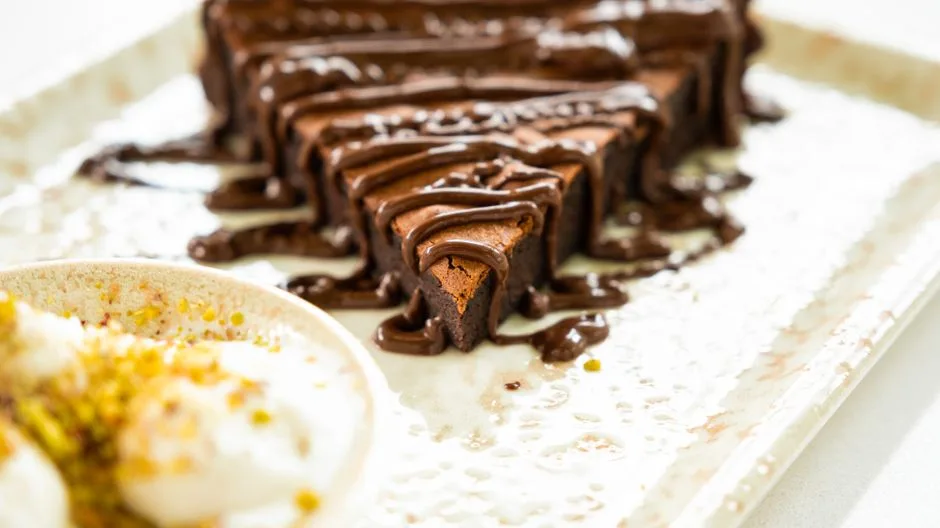
Gluten-Free Brownie Recipe: Fudgy Squares With a Shiny Crust
If you are looking for a brownie recipe you can bake gluten free, the one below is the version we would point a reader to first: butter and dark chocolate melted together, both sugars whisked in while the mixture is still warm, eggs beaten hard to build the thin shiny crust, and only about 90 g of gluten-free flour blend folded in at the end. Brownies are the most forgiving chocolate bake to convert, because the structure comes from melted chocolate, eggs and sugar rather than from a developed gluten network. That is why a straight swap of a gluten-free all-purpose blend for wheat flour usually works here, while the same swap in bread or puff pastry does not. Bake in a lined 20 cm (8-inch) square tin at 175 °C / 350 °F for roughly 25–30 minutes, then cool completely before cutting. Everything below explains the choices in that recipe so you can steer it toward the texture you actually want.
Gluten-Free Fudgy Brownies
Ingredients
- 170 g unsalted butter, cubed
- 200 g dark chocolate (60–70% cocoa), chopped
- 250 g granulated sugar
- 50 g light brown sugar, packed
- 3 large eggs, at room temperature
- 2 tsp vanilla extract
- 90 g gluten-free all-purpose flour blend containing xanthan gum
- 30 g unsweetened cocoa powder
- 1/2 tsp fine sea salt
- 85 g gluten-free dark chocolate chips (optional)
Instructions
- Heat the oven to 175 °C / 350 °F and line a 20 cm (8-inch) square tin with parchment, leaving an overhang on two sides.
- Melt the butter and chopped chocolate together in a heatproof bowl set over barely simmering water, or in short bursts in the microwave, stirring until smooth; set aside for 5 minutes to cool slightly.
- Whisk the granulated and brown sugar into the warm chocolate mixture until it looks thick and glossy.
- Whisk in the eggs one at a time, then the vanilla, and beat hard for about 1 minute after the last egg goes in.
- Sift the flour blend, cocoa powder and salt over the batter and fold with a spatula just until no dry streaks remain.
- Fold in the chocolate chips, if using, then scrape the batter into the tin and level the top.
- Let the filled tin stand for 20–30 minutes so the flour blend hydrates, which helps avoid a gritty texture.
- Bake for 25–30 minutes, until the edges are set and the centre is only just firm; a skewer in the middle should come out with moist crumbs.
- Cool completely in the tin for at least 2 hours, then lift out using the parchment and cut into 16 squares with a hot, dry knife.
Why brownies convert so easily to gluten free
In a wheat brownie, flour is a minor structural player. The chew comes from sugar dissolved in fat and egg, the fudginess from the cocoa butter in melted chocolate, and the rise from air beaten into the eggs. Flour is there mainly to bind and to stop the whole thing from turning into a chocolate pudding. Remove gluten from that job description and very little is lost.
This is also why a brownie recipe is a sensible first test of any new gluten-free flour blend in your cupboard. If the blend is going to taste chalky or feel gritty, a dark, sweet, high-fat batter hides it better than almost anything else you could bake. And because the flour quantity is low, the differences between rice-based, sorghum-based and oat-based blends show up as small texture shifts rather than failures.
- Low flour ratio: roughly 90 g of blend to 200 g of chocolate and 300 g of total sugar
- Melted chocolate, not creamed butter, carries the structure
- No kneading, proving or lamination, so no gluten network to replace
- Cocoa and dark chocolate mask the flavour of starchier blends
Choosing a gluten-free flour blend for brownies
A cup-for-cup or 1:1 all-purpose gluten-free blend that already contains xanthan gum is the simplest route and the one the recipe assumes. If your blend has no gum, you can still bake it: add about 1/4 teaspoon of xanthan gum, or accept a slightly more crumbly square, which many people prefer in a fudgy brownie anyway.
Blends that lean on white rice flour give a clean, neutral result but can feel faintly sandy if the batter goes straight into the oven. Letting the mixed batter sit in the tin for 20–30 minutes before baking gives the starches and flours time to take up moisture, and in our editorial view that single pause does more for gluten-free brownie texture than swapping brands. Blends built on sorghum, buckwheat or oat flour bring more flavour of their own, which suits a dark, less sweet brownie.
Single flours work too, with caveats. Almond flour makes a dense, moist, slightly greasy brownie and needs a little less butter. Buckwheat gives an earthy, almost rye-like depth. Pure starches such as tapioca or potato starch used alone tend to turn gummy, so keep them as part of a blend rather than the whole flour.
- Easiest: 1:1 gluten-free all-purpose blend containing xanthan gum
- No gum in the blend? Add about 1/4 tsp, or accept a softer, crumblier square
- Rest the batter 20–30 minutes to reduce grittiness from rice-based blends
- Almond flour: reduce the butter slightly and expect a denser crumb
- Avoid using pure tapioca or potato starch as the only flour
The method, and what each step is doing
Melt the butter and chopped chocolate together gently, then let the mixture cool for a few minutes before the sugar goes in. Adding sugar while the mixture is still warm helps it partly dissolve, and dissolved sugar is what gives brownies their glossy, papery top rather than a dull matte one.
The eggs matter more than the flour. Whisk them in one at a time and then beat hard for about a minute after the last one. That beating dissolves more sugar and works fine bubbles into the batter; those bubbles rise, the sugar crystallises at the surface, and you get the thin crackly crust. Skipping this step is the single most common reason a brownie comes out tasting right but looking flat and dull.
Once the flour, cocoa and salt go in, switch from whisk to spatula and fold only until the dry streaks disappear. There is no gluten to overdevelop, but overworking the batter knocks out the air you just built and can make the crumb tight and rubbery.
- Cool the melted chocolate and butter briefly so the eggs do not scramble
- Whisk sugar into warm, not hot, chocolate to help it dissolve
- Beat for about a minute after the last egg for the shiny crust
- Fold in the dry ingredients by hand, stopping as soon as they disappear
Fudgy, chewy or cakey: what to change
One brownie recipe can produce three quite different bakes depending on fat, flour and how long it stays in the oven. Decide which you want before you start rather than hoping the tin surprises you.
For fudgier squares, keep the flour at the low end, use more melted chocolate than cocoa powder, and pull the tin when the centre is only just set. For chewier squares, brown sugar and an extra egg yolk help, because both hold moisture and keep the crumb elastic. For a cakier brownie, add 25–30 g more flour blend and 1/2 teaspoon of baking powder, and bake a few minutes longer.
Pan size changes the outcome as much as any ingredient. The same batter in a 23 cm (9-inch) tin spreads thinner, sets faster and comes out chewier at the edges; in a 20 cm tin it stays thicker and fudgier in the middle. If you scale up to a rectangular tin, expect to add several minutes and check the centre rather than trusting the clock.
- Fudgier: less flour, more melted chocolate, shorter bake
- Chewier: swap some granulated sugar for brown sugar and add an egg yolk
- Cakier: add 25–30 g flour blend plus 1/2 tsp baking powder
- Thinner pan equals faster set and chewier edges
- Underbaking slightly is far easier to recover from than overbaking
Keeping the recipe genuinely gluten free
The flour is the obvious risk, but it is rarely the only one. Chocolate chips, cocoa powder, baking powder, vanilla extract and flavoured salts can all be produced on shared equipment, and some gluten-free flour blends sold outside the United States contain specially processed wheat starch, which is intended to be suitable for a gluten-free diet but will not be acceptable to everyone. Read the label rather than the front of the bag.
In a shared kitchen, the practical hazards are airborne flour, a wooden spoon that has stirred wheat batter, and a sieve that was rinsed but never scrubbed. Brownie batter is thick and sticky, so anything that touches it needs to be genuinely clean.
If you plan to add oat flour or rolled oats, use oats specifically labelled gluten free, since standard oats are commonly handled alongside wheat. Whether oats belong in a gluten-free diet at all is a question for the person eating them and their clinician, not for a recipe page.
- Check labels on cocoa, chips, baking powder and extracts, not just flour
- Some blends contain processed wheat starch; confirm it suits your needs
- Use clean tins, sieves, spatulas and parchment in a shared kitchen
- Choose oats and oat flour that are labelled gluten free
- Line the tin with parchment rather than dusting it with flour
Doneness, cooling, cutting and storing
Gluten-free brownies look wetter than they are while hot, because the starches have not finished setting. Judge by the edges first: they should be visibly firm and pulling away slightly from the parchment, while the centre still has the faintest wobble. A skewer pushed into the middle should come out with moist crumbs clinging to it, not with liquid batter and not clean.
Cooling is not optional here. Gluten-free starches firm up as they cool, and a brownie cut warm will smear rather than slice. Leave the slab in the tin for at least two hours, or refrigerate it for an hour if you want sharp edges. Lift it out using the parchment overhang and cut with a long knife warmed under hot water and wiped dry between cuts.
Stored airtight at room temperature, the squares keep well for a few days and often taste better on day two, once the chocolate has settled. They also freeze well: wrap individually, freeze, and thaw at room temperature or warm briefly so the centre softens again.
- Set edges plus a faint wobble in the centre is the target
- Skewer test: moist crumbs, not wet batter, not bone dry
- Cool at least two hours in the tin, or chill for clean edges
- Hot, dry knife between cuts for squares that do not crumble
- Airtight at room temperature for a few days, or wrap and freeze
Frequently Asked Questions
Can I swap a 1:1 gluten-free blend straight into a normal brownie recipe?
In brownies, usually yes. The flour quantity is small and the structure comes from melted chocolate, sugar and eggs rather than from gluten, so a cup-for-cup all-purpose blend measured by weight is the closest thing to a direct substitution in gluten-free baking. Expect the batter to look slightly thicker, and give it a 20–30 minute rest in the tin before baking.
Do I need xanthan gum?
Not strictly. Xanthan gum adds cohesion and makes the square hold together more like a wheat brownie, which is helpful if you want neat slices to transport. Without it, the brownie is a little more crumbly at the edges, which plenty of people prefer in a fudgy bake. If your blend contains no gum, about 1/4 teaspoon sifted in with the flour is enough.
Why do my gluten-free brownies feel gritty?
Almost always because a rice-flour-based blend went into the oven before it had absorbed enough liquid. Resting the mixed batter for 20–30 minutes usually fixes it. A finer-milled blend, or one built on sorghum or oat flour instead of coarse white rice flour, also helps, as does making sure the melted chocolate mixture is still warm when the dry ingredients are folded in.
Can I make these without melted chocolate, using only cocoa powder?
You can, but it becomes a different bake. Melted chocolate brings cocoa butter, which is what makes a brownie dense and fudgy. A cocoa-only version needs more butter and tends toward a cakier, drier crumb. If you go that route, increase the cocoa to roughly 75 g, keep the butter generous, and be even more careful not to overbake.
Are brownies naturally gluten free?
No. Standard brownies contain wheat flour, and boxed mixes usually do too. What is true is that the recipe adapts more easily than most baked goods, because so little flour is involved. The remaining work is checking the other ingredients, since cocoa powder, chocolate chips, baking powder and extracts can be produced on shared equipment.
Related guides